

What Do You Like About Him? (And Other Crimes Against Teenagers)
My daughter had a boy over for dinner last week. I did what I assumed any reasonably socialized adult does when a stranger sits down at her table and eats her food. I asked him about himself.
Where does your family live? How many siblings do you have? What do your parents do? What do you all like to do for fun?
He answered. Briefly. Politely. With the energy of a man reading his own ransom note.
After he left, I said to my daughter, "He's quite shy, isn't he?"
She looked at me the way teenagers look at adults who have just revealed themselves to be the problem. "I think he's scared of you."
"Scared of me? Why?"
"Because you interrogated him."
Exhibit B: the Target incident
This was not, I should note, a singular offense. I was also accused of “interrogating” a friend of hers who came with us on a Target run. When the girls started talking about a boy the friend liked, I asked one question. What do you like about him?
Not "Is he good to you?" Not "What are his intentions?" Not "What's his GPA and does he have a car?" Just: what is it about this person that you like?
Later, my daughter informed me that I had made her friend uncomfortable.
So I've been sitting with it. Am I the Spanish Inquisition or is something else going on?
I've heard this complaint before
Here's the thing: this isn't the first time teenagers have found my questions unbearable.
Before I worked in cybersecurity, I taught high school English and often used the Socratic Seminar as an assessment tool. If you've never had the pleasure, a Socratic Seminar is a structured discussion. Students sit in a circle and talk to each other about a text, and the teacher mostly stays out of the way. We talked about the big themes in the literature we read: hubris, feminism, racism. There was no worksheet to hide behind and no right answer to copy down. You had to say what you actually thought, out loud, in front of your peers, and then defend it.
Some loved it, but others hated it. The groaning was real, and it was consistent across years and class periods. I used to chalk it up to the usual adolescent allergy to anything assigned. Now I'm wondering whether the seminar and the dinner table have something in common.
The question that takes a minute
This week's Talk newsletter from Alison Wood Brooks, the Harvard Business School professor who studies conversation, included a prompt card I can't stop thinking about:
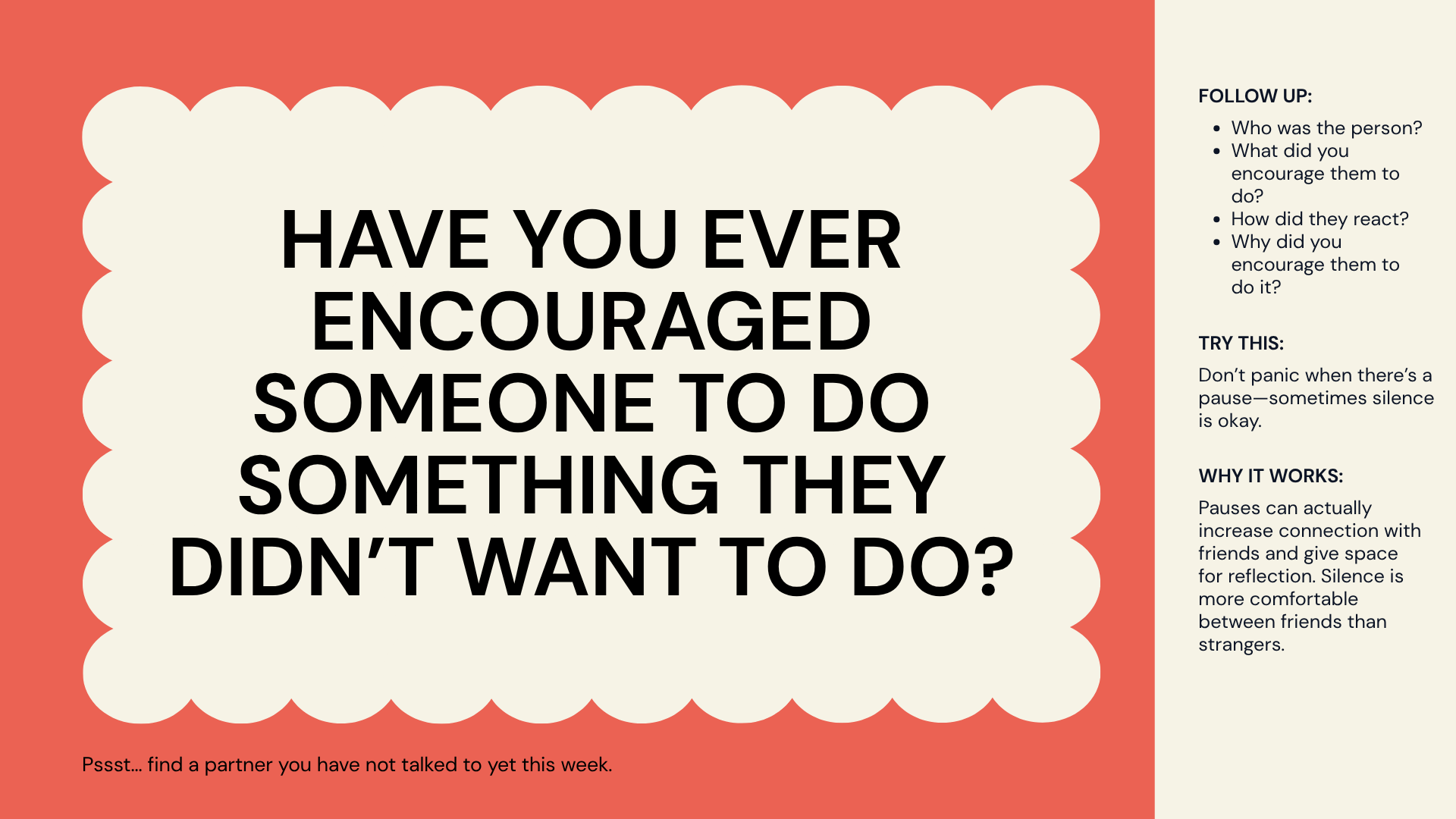
Question of the day from TALK Studio.
Note the suggested follow-ups in a little sidebar. It’s the advice that made me sit up: Don't panic when there's a pause. Sometimes silence is okay.
That is not a question you can answer on autopilot. You have to search your memory. You have to decide whether you were the encourager or the pressurer, and whether those are different things. You have to figure out how honest you want to be. All of that takes a beat. Maybe several.
Which is my working theory about what's happening with my daughter's friends, and with my former students. When a question requires actual thought, it requires silence. And for a lot of teenagers, silence in front of an adult feels like failure in real time. The pause isn't reflection; it's an exam they're flunking while you watch.
The same card offers a second observation that I think explains the rest: silence is more comfortable between friends than between strangers. My daughter's friends and I are not friends. At my dinner table, a pause doesn't feel like space. It feels like a spotlight.
In fairness to the jury
I would love to end this post with "Kids today can't handle a conversation," and call it a day. But I spent too many years teaching close reading to skip the part where I reread my own evidence.
Brooks's research is known for a finding that sounds like it vindicates me: people who ask more questions, especially follow-up questions, tend to be better liked. Asking is good. I was asking. Case closed?
Not quite. Look again at what I asked that boy. Where do you live? How many siblings? What do your parents do? What do you do for fun? That's not a conversation; that's an intake form. Each question was a fresh topic, and none of them built on what he'd just said. If you're fifteen and nervous and sitting across from your friend's mother, four unrelated questions in a row probably does feel less like curiosity and more like a background check.
The Target question was different. What do you like about him? followed the conversation the girls were already having. It was a genuine follow-up. It was also a thinking question, the kind with no rehearsed answer, and that's where the discomfort came in.
So maybe the truth is a little of both. Sometimes I'm asking questions that require thought, and the silence that follows feels unbearable to someone who hasn't learned that a pause is allowed. And sometimes I'm firing off a checklist, and the kid is right to feel processed.
What I'm keeping, and what I'm changing
I'm not going to stop asking my daughter's friends questions. Teenagers are already surrounded by adults who talk at them and screens that never ask them anything at all. A grown-up who is genuinely curious about what they think might be one of the more useful things I can offer, even if it registers as mildly terrifying.
But I can ask better. Fewer questions. More follow-ups. Less "What do your parents do?" and more "Wait, tell me more about that."
And I can do the thing the card recommends: Let the pause sit there. Let it be okay.
In a Socratic Seminar, my best moments as a teacher were the ones where I said nothing and let a room full of sixteen-year-olds sit in discomfort until someone finally said something true. I knew then that silence was where the thinking happened.
I just forgot that it takes a while for kids to learn that a pause isn't a punishment. Apparently it takes a while for their mothers to learn it, too.